The perks and perils of the “Privileged Semi-Untouchables”

IMG_0652
Five or six times each day I push my grimy feet into the nearest pair of shoes and venture outside with Mishka so she can do her business. After wending our way through the stilettos and Beamers, smoking bros and Bentleys in the parking lot downstairs, Mishka does the deed. The lives of the Kazakh young and rich come to a momentary, screeching halt as they stare: it’s almost guaranteed that I am wearing 1.) pajamas or 2.) sweaty running clothes, and I am picking up Mishka’s “deed” in a little plastic bag. With my hands.

On one such occasion, a construction worker asked me why I pick up the dog pooh. Unfortunately, the limited amount of Russian I know wouldn’t have allowed me to reply, “Because it’s polite,” or “Because I would probably step in it the next time I come outside with the dog.” Instead, I answered, “Я Американка,” or “I am American.” And as weird as this answer is, it’s actually desperately accurate. Yes: I pick up the dog pooh because I am an American.

The moniker “Priviledged Semi-Untouchables” is not my own, but Sam’s. He coined this phrase one evening while we were talking about Almaty’s opulent emergence from Soviet rule, and its spectacular wealth set against a much larger backdrop of filth and corrugated steel. We, as American diplomats, sit somewhere in the middle. We appear (or are assumed to be) wealthy based on where we live, and the fact that we are Americans. But we aren’t—our closets aren’t brimming with beautiful clothing; our car is just a modest Toyota.

Still, we can get away with things that only the truly fabulously rich can: wearing pajamas in public; eschewing corrupt bribery attempts by the local police; going to expensive restaurants to eat, not just to be seen. We maintain celebrity status just for being Americans, but are approachable because we aren’t amongst the truly un-touchable Kazakh elite. We exist in status purgatory, floating somewhere both outside of and exactly in the middle of the dominant Kazakh socio-economic groups.

Many of my faithful readers know that (when I’m not running or writing or tending to the animals in my life) I’m building an online art business. Unfortunately, Sam and I are still waiting for the bulk of our belongings to arrive in Kazakhstan—and with them my art supplies. Sure, Kazakhstan has artists, and art stores, but nothing like we have in the states. In a “developed” country, the art stores are practically bursting with potential. In a “developing” country, you best not expect to even find an art store. Here, in a so-called “second world country,” you never know what you’re gonna get. It might be a random assortment of ceramic tools; it might be lovely drawing paper, but nary a drawing pencil in sight; or it might be—as was the case on my most recent art store visit—post-it-notes and binders.

I spent half of my bike ride home cursing Almaty for its shallow-showy-ness, $60-steak-Porsche-store-in-the-mall-ness, while its art stores are filled with little more than poorly assembled notebooks and cheap watercolor paints—the sort that were on your back-to-school shopping list in 2nd grade. I spent the other half of the ride thankful, almost to tears, that I grew up in a place where I had access to so many mind-opening, quality art materials, and money enough to buy them.

Since arriving in Almaty, I’ve spent hundreds of dollars on art supplies from America. I’ve made friends with the folks at the Paper Source headquarters in Chicago, and convinced them to do their first all-email cutting order. I’m fairly certain that I’ve become Dick Blick’s newest favorite customer. And while I’m willing to accept that life overseas will be full of compromises, art supplies is one area where I’m not sure I’ll ever be able to find that middle ground.

MORE VODKA

pickles 2STUFF. IS. AMAZING. I say with this absolutely no shame after tearing into my birthday packages from the states. It was one week after my birthday. I was holding a pair of kitchen shears in one hand, an extra-large vodka-diet-soda in the other: you better believe this was my own personal celebration. No sooner than I tore into the package from my parents was I wearing each of the items that they sent. Next came my best friend’s birthday gift: fudge, effing glorious fudge. I ate myself sick on the stuff, and by some miracle, avoided getting any of it on my brand new birthday dress. And then came the art stuff. Box after heavenly box of quality art supplies. I worked myself into such a frenzy that I dropped the kitchen shears and sliced my shin. I narrowly avoided getting blood on the birthday dress. TOTALLY. WORTH. IT.

I never thought I was a stuff person, but I am officially a stuff person. The result of living five+ weeks in Kazakhstan has me dancing around the dining room when I open a bulk shipment of rice cakes. (Central Asia + gluten intolerance = “Um…is it rude if I just eat the meat part of the noodle dish?…”)

When Sam and I received the first shipment of our stuff from the U.S., it was like Christmas, plus birthdays, plus all other occasions where you get presents in the Kraegel homestead. I woke up early with butterflies in my stomach; the first box-dragging-across-the-floor sounds outside our apartment door sent me tearing back into the bedroom to wake Sam up. “Paxton [the moving company—or the Kazakh equivalent] is here!” I yelled, but I might as well have been saying “There’s a man with a giant cardboard check standing on our stoop!” or “There’s a dinosaur in the front yard!” or “FIRE!”.

I was powerless as soon as the Trader Joe’s black liquorice surfaced—who cares that it was 7:30 a.m., I’ve never tasted anything so delicious. Almaty may be the New York City of Kazakhstan (and there’s plenty available ‘round these parts), but there’s nothin’ quite like good old American stuff. Familiar stuff. MY stuff.

Among the things that I DO love about Almaty: Coca Cola Light (it’s much better than Diet Coke), MEGA Bacon chips, mini pickles, the enforced “variety pack” of beer—sold individually by the bottle or can—and the price of vodka.

Which brings me to an interesting theory: I believe that in Central Asia, vodka makes everything better. For everyone. Twenty odd years after the fall of the Soviet Union, the only Russian cultural leftover more pervasive in Kazakhstan than the language (duh), or the architecture, is the vodka. The vodka selection at the grocery stores is astonishing; the prices even more so—a decent 750 ml bottle averages about 1,200 Kazakh tenge, or eight American dollars. (But don’t get too excited. Many bottles also go for well over $100.)

I have yet to graduate to the Russian style of vodka consumption—neat and very cold, preferably accompanied by mini pickles and salted fish, and often served as a palette cleanser. Instead, my poison is the vodka-diet-coke (despite the fact that combining vodka with “mixers” is a distinct no-no in this part of the world). For the curious, my recipe is as follows:

– 4 ice cubes
– ½ squeezed, fresh lime
– 2 fingers of vodka
– Coca Cola Light, to taste

After enjoying one (or two?) of these babies on a recent evening, I headed to the store to purchase, um, more vodka and limes. On my way, something magical happened. It was as if being slightly “vodka-happy” granted me access to a parallel universe where the prolonged stares I receive from passersby on the sidewalk felt welcome and natural. Where wearing pantyhose with every outfit (under jeans, with flip-flops) was suddenly fashionable. Parking one’s car on the sidewalk? Go for it! Who am I to deny someone this convenience? My filthy, developing-country-feet became only a passing annoyance—one might even call it charming. And to the cashiers at the grocery store who demand that I use smaller bills because they don’t want to give up theirs: of course you can have my small bills!

It was the vodka, I know. I see now why vodka was once reserved for nobility, and was even thought to be good for one’s health. It makes life in Central Asia downright manageable…even enjoyable! And now, in honor of our new favorite beverage:

There cannot be not enough snacks, 
There can only be not enough vodka. 
There can be no silly jokes, 
There can only be not enough vodka. 
There can be no ugly women, 
There can only be not enough vodka. 
There cannot be too much vodka, 
There can only be not enough vodka.
– Russian saying

…and to this my friends, I say again: more vodka.

Diplomatic relations

diplomaticrelations

I am writing this post on my 32nd birthday. On this day, I have been in Kazakhstan for longer than I’ve been in any other foreign country. Coming in at a close second is Ghana; Peru and Thailand are tied for third. In my 32 years of life, I have been outside of the U.S. a total of only three-and-a-half months.

The last 32 days of my life have been some of the most confusing, infuriating, frightening, and (somehow) fulfilling days I’ve known: coordinating all of the moving parts that would help us make the transition to Kazakhstan; leaving dear friends behind; making new ones; navigating a culture that is slow to smile, and short on manners; and becoming an artist without having to answer the inevitable query: “But, what do you really do?”

The last 32 minutes have included writing the first two paragraphs of this blog entry, then realizing that an eerie calm has settled over the house. Normally a good thing, this is not the case when a brand new puppy—my birthday present from Sam—is in the picture. Officially: quiet equals trouble. Only moments after I realize Mishka is missing, she comes trotting into my studio, blinking innocently, cat litter thoroughly coating her wet, black nose.

I know that I will find an explosion of cat litter in the bathroom. I will also find, if previous episodes are any indication, a litter-covered cat turd in the hallway. And I do. Mishka watches me clean up the mess with a joyful, satisfied, puppy smile, while Hank, peering at us from under the guestroom bedsheets, fails to conceal his revulsion.

I have to give Hank a lot of credit. He is an opinionated creature, but truly sweet-natured. He has been a patient older brother—no claws, no cussing. In fact, he has spent much of the last two days wrapped tightly in the bedsheets in what we’ve been calling a cat-tortilla, eager to escape the shrill whining and puppy-teeth gnashing just beyond his bedroom door.

Me and Mishka go on a lot of walks. Because of the frequency of our walks, the people in and around our building have started recognizing us, and talking to us—in Russian. At this point I’ve gotten pretty good at saying (in Russian), “I’m sorry, I don’t understand” in response to their quick-fire questions about the dog. At very least, I can eek out a “Her name is Mishka.”

This exact sort of exchange happened with a group of children in the park behind our apartment building. Having just gotten out of school for the summer, they were running around like wild things. Obviously they wanted to play with Mishka. A group of five approached me nervously, ranging in age from four to nine, and ranging widely in ethnicity: from very blond and Russian-looking to very dark with Mongolian features. (Genghis Khan’s reign included most of modern-day Kazakhstan.) I had never spoken to children who speak another language; their frustration with me was palpable. While I was able to tell them that yes, Mishka is a puppy, not a dog (or a wolf—as one of them asked), I was completely unable to answer any of their other questions. One of the little boys spoke a tiny bit of English, and was able to do some translating, but I knew our exchange was officially over when he had to lean over to the littlest girl in the bunch and whisper, “She doesn’t understand.” In response, this little girl glanced up at me with an expression of complete confusion. Why would a grown person not understand?

As me and Mishka walked away I turned and yelled, “See you soon!” over my shoulder. Rather than return my goodbye, all five started calling out, with noses pinched, “Bock! Bock! Bock!” Apparently, this is how Americans sound to Russian-speaking people. And after I recovered from the weirdness of this exchange, I realized that they’re right. Americans do, indeed, speak through their noses—the “nasal resonator” if we’re being technical—while Russian-speaking folks are much more likely to use their throat to get their point across. In fact, it is fairly common practice in Central Asia to pinch your nose when you’re talking about American-made movies that have been only somewhat successfully dubbed over, as the nasally American English can still be heard.

Despite the fact that a large percentage of Kazakhstan is Muslim, dogs are still welcome members of society in Almaty. (Given the cosmopolitan nature of this city, religion is not a significant factor in everyday life.) But, in wild contrast to America, Kazakh dogs are not typically considered members of the family. On one of our walks, Mishka and I had a particularly interesting exchange with a group of Kazakh laborers who were taking a break on the side of the road. Somewhat embarrassingly, they were seated close to Mishka’s favorite pee-patch. All six men, squatting in the traditional Asian style, appeared to be wondering why I led my dog to the patch—but all was revealed when Mishka squatted to pee. In response, a hushed “Ohhh!” escaped from the lips of each of the men. Initally, I was horrified, and assumed I had gravely offended the group. But there was some delight in their response, as if they were impressed that she had done her business in the location of my choosing. I was unwilling to stick around to find out which it was. As I write today I’m still unsure.

It is through daily diplomatic exchanges like these that Mishka and I are making our way in our new environments—she, a Kazakh street mutt, now living in an American household, and me, an American artist, carving out a new life as an expat.


Bugs: be gone!

IMG_0597
In order to escape smog-filled Almaty, you need only to ascend to 6,000 feet above sea level. And it’s almost as easily done as said: a quick 20 minute drive has you in the picturesque Tien Shan mountain range that skirts Almaty’s southern and eastern edges. “The Lungs of Almaty” indeed. The air is cool and dry; the lack of car exhaust is noticeable immediately. And the hiking, oh my goodness, the hiking.

This is not a leisurely afternoon stroll. These foothills are for real. A two-and-a-half hour hike has you ascending an additional 3,000 feet through scrubby grasses, gurgling mountain streams, and proud pines. Even the sunlight plays along. The light always seems to have that lovely late-afternoon quality—polarized just so, for perfect photographs with bold, colorful statements.

And then you find a tick.

Oh my god! Get it off, get it off!

May and June are tick months in the Almaty foothills. Regular tick checks are advised; the CDC recommends looking in the following places:

– Under the arms
– In and around the ears
– Inside belly button
– Back of the knees
– In and around the hair
– Between the legs
– Around the waist

If you couldn’t tell already, this is a good time to for me to share: I am particularly sensitive about ticks. This is because my brother contracted Rocky Mountain Spotted Fever from a tick when he was very young. Yes, this is a real disease. Did the tick who gave it to him travel all the way to Illinois from the Rocky Mountains to do so? One might think. But this incident (which had him hospitalized for more than a week), has left me with the indelible sense that ticks are sinister, blood-sucking villains.

So you can imagine my horror when I found one happily sucking blood just under my right boob. What I did next is NOT what the CDC tells you to do: “If you find a tick attached to your skin, there’s no need to panic.” Ha, yeah, right. “Remove the attached tick as soon as you notice it by grasping with tweezers, as close to the skin as possible, and pulling it straight out.” Instead, I grasped the little bugger between my fingers, and in one smooth motion, yanked the tick from my skin and threw it out the open car window. Shudder.

In Central Asia there is a disease called Tick Borne Encephalitis (TBE) that, if contracted and left to its own devices, can lead to meningitis, permanent nervous system damage, and sometimes (though rarely) death. This little bit of info, combined with the fact that Sam and I had only done the first of a three-course TBE vaccination, had us mildly concerned. It wasn’t until one week PTB (post-tick-bite)—when I fell asleep for an entire afternoon, then abruptly awoke at 1:00 a.m. to puke my guts out—that Sam and I decided I was on the fast track to TBE-induced paralysis.

But really I wasn’t. Luckily, as diplomats, we have access to a pretty great medical facility. A 15 minute chat with the doctor revealed that I had exactly the same stomach bug that the other American expats had suffered in the past few weeks. “It’ll pass in 2 or 3 days,” he said, as he handed me something called Vomiz which—you can guess from the name—is meant to help with nausea and, well, vomiting. And for those of you concerned about future tick episodes [ahem, parents], we also got the second shot in the TBE series.

Welcome to Central Asia.

As I write today, I am still slightly suffering the after-effects of the stomach bug. I haven’t eaten much except bananas and peanut butter for the last three days. I have vowed to drink an entire two-liter bottle of water this afternoon, and I would probably murder someone for a bowl of Campbell’s chicken noodle soup right now.

But despite all of this, the mountains beckon. I truly can’t wait to get out there on those majestic, sunlight-filled, tick-covered hillsides once again.

Tacos taste like home

ImageMeant as a message about the importance of learning how to read, this children’s story has been on my mind a lot lately: The Little Old Man Who Could Not Read, by Irma Simonton Black, is about, well, a little old man who could not read. While he toils all day in his toy-making shop, his loving wife takes care of the household chores, namely grocery shopping. But when she goes away for the weekend, our dear little old man is left to fend for himself.

The adult mind may find it hard to believe that a talented toy-maker could be quite as befuddled as he is by a trip to the grocery store. But as a five-year-old, this story is riotous. Not only because it seems improbable that an adult wouldn’t know how to read, but because the visualizations are so compelling—the shape of a spaghetti box does look an awful lot like a wax paper box! In the end, our protagonist gets so hungry that he is left with no choice:

“First the old man learned to read the word spaghetti.
 Next he learned to read the word milk.
 Then he learned to read the words for everything in the big store.
 And then he learned to read the words for everything in the world.”

Three weeks in Russian-speaking Almaty has me feeling exactly like our little old man. I stand in the aisles blinking, bewildered by the Cyrillic characters. As a result, I have begun to describe my days here as “one-, two-, or three-grocery-store days” depending on the number of supermarket stops I’ve made. (I don’t think I’ve ever been to four grocery stores in one day, but I don’t doubt a “four-grocery-store day” is in my future.) I am guilty of purchasing three separate items, each with a picture of a chicken, in the hopes that one of them would be chicken bouillon. (One was!)

I need to learn how to read. Russian.

Adding to this complication is the fact that grocery stores in Kazakhstan are arranged as follows: baby stuff, baked items & chocolates, soap (all kinds), juices & beer, canned foods, grain products, dairy, and meat. Sometimes there are fresh fruits and vegetables. More often, there are diapers in the same isle as the cheese, or remote-controlled cars next to the bread. And every animal comes canned—except tuna.

I could go on about the lack of logical organization. I could bemoan the time wasted making laps around the store. Instead, I am attempting to see each day as an opportunity for tiny successes. TINY. Like correctly pronouncing the name of the street where the grocery store is located. Slightly bigger? Working up the nerve to ask—in Russian—the man at the meat counter for a half-kilo of ground beef. Even bigger? When the man at the meat counter understands me, and hands me that half-kilo of ground beef.

And what does one do with ground beef in Kazakhstan? Make tacos, of course—with a little help from Old El Paso taco packets, and some fellow expats who had a boatload of the stuff shipped from the states. Talk about success! These tacos (pictured below) are the crowning achievement of my culinary adventures in Kazakhstan so far. It is important to note that Sam has always been the cook in our family, but I’ve graciously accepted cooking as one of my new housewifely duties. For me, yes, tacos are absolutely an achievement. Partially because I never would have thought that tacos in Kazakhstan were possible—but mostly because they tasted like home.
Image

Sh*t-hawk: “The Worst Day of Hank’s Life” meets a wet end

There is no better way to make an excellent first impression than to be smelling of cat shit. This was what Sam and I decided as we elbowed our way through the arrivals crowd at Almaty International Airport, carrying a desperately dehydrated Hank who spent the last 16 hours squeezing every bit of reeking cat liquid from his body. His deluxe carrying cage with durable mesh sides and removable fleece pad had become little more than a pricey litter box…

It began before we even left the ground at Dulles. And by the time I was able to carry a stinking Hank and his stinking cage to the airplane bathroom, he had given himself an artful skunk stripe of cat poop—a shit Mohawk, a shit-hawk—down the middle of his back, from the scruff of his neck to the base of his tail. I couldn’t believe this was happening. But I also wouldn’t have believed it is possible to give a cat a bath in an airplane bathroom. With wet-wipes and paper towels. It is.

The nastiness continued until we landed in Germany…and continued still as we made our way to Almaty. It was 1:00 a.m. when we landed. We were delirious from the lack of sleep and the awfulness of the cat situation. We told Chris—Sam’s coworker charged with picking us up at the airport—that he probably didn’t want to shake our hands. That he absolutely didn’t want to touch the cat. Oh, and he would almost certainly need to roll the windows down in the car, too.

Poor Hank. To add insult to injury, Hank also got the first real bath of his life when we arrived at our new apartment. This required that I kneel naked in a bathtub of poopy water, Hank pinned between my knees, Sam vigorously scrubbing.

Pantene ProV—you miracle-worker! Two weeks later, Hank has never looked so good. He recovered entirely from the ordeal, which included evacuating—in 12-inch-lengths, from both ends of his body—the four feet of string that had mysteriously disappeared from our hotel room in Washington. Now, Hank happily supervises our nearly daily visits from U.S. consulate folks, air conditioning repairmen, and cable television installers. His carrying cage has returned to its original state, and he couldn’t be happier—every window in our apartment has a perfectly cat-sized ledge from which he can view the world.

For me and Sam, “The Worst Day of Hank’s Life” has become a distant, hilarious memory. While we aren’t adjusting to our new life in Almaty nearly as quickly as Hank did, the transition has given us many opportunities to weigh the benefits of life in the foreign service against the difficulties of leaving our old life behind—afterall, you can’t have the cat without having the cat shit, too.

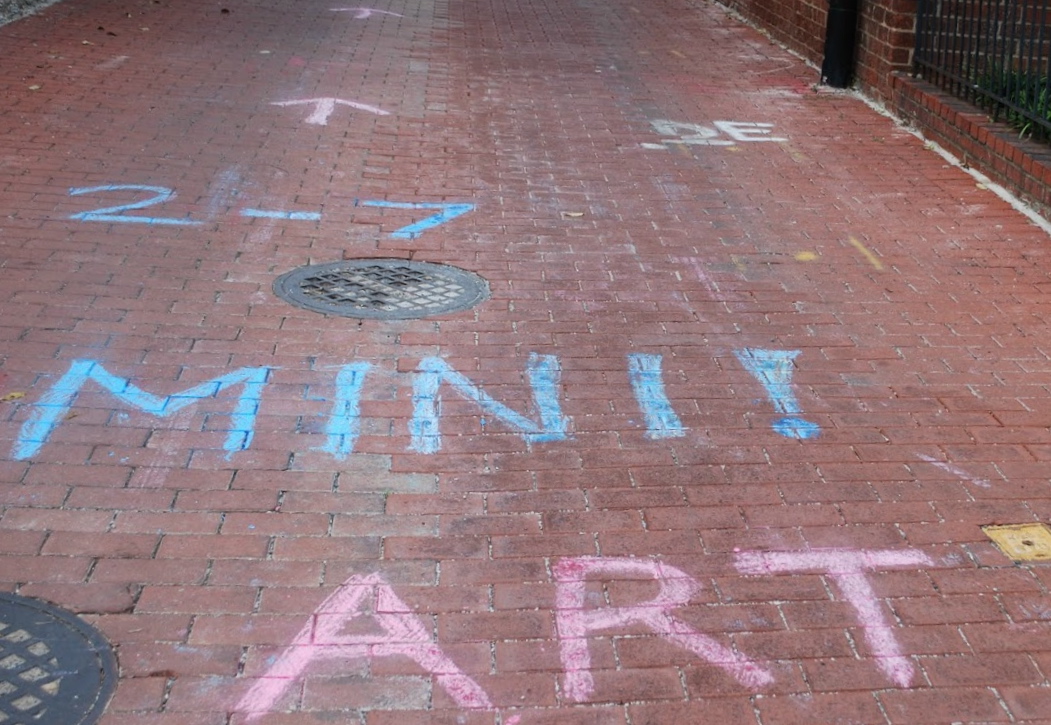
ART NIGHT, sept. 27

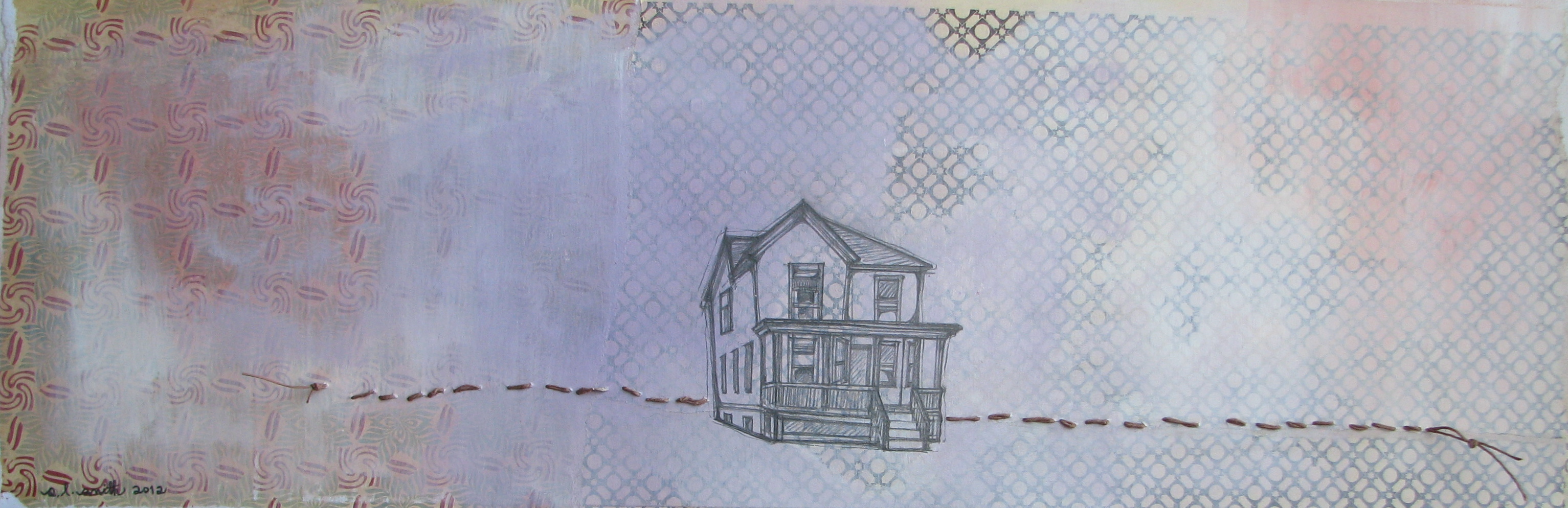
On September 27th, Washington Project for the Arts (WPA) teamed up with Hickok Cole Architects to present its annual ART NIGHT. Curator Judy Sherman selected me and many other regional artists to present our work. I displayed my ‘home series,’ visible below. Thank you to Judy Sherman, WPA, Hickok Cole, and everyone who attended this wonderful event!

home series, summer 2012

the Silverdale
2012
graphite, acrylic and collage materials on canvas
8 x 24in.
$225

the Livingston
2012
graphite, acrylic and collage materials on canvas
8 x 24in.
$225

Modern Home no. 185
2012
graphite, acrylic and collage materials on canvas
8 x 24in.
SOLD